How to Deliver a Pharmaceutical Packaging Kit Order Right: Lessons from a 57,000-Set Vaccine Packaging Shipment
When a pharmaceutical packaging kit arrives with one carton colour, leaflet, label or bag out of sync, the problem is not “just packaging.” It can stop assembly, make inventory hard to reconcile and leave the buyer deciding which component belongs to which specification. The most useful delivery discipline is therefore not a prettier carton; it is a system that keeps every component, factory and shipping document connected.
This playbook is written from the buyer’s viewpoint. It draws on an anonymised combined shipment for a pharmaceutical distributor in the Philippines: two consecutive packaging-kit orders, one for a rabies vaccine packaging kit and one for another injectable product in two strengths, aggregated into one 57,000-set shipment. The goal is not to present that order as a universal template. It is to show the operational decisions that help a multi-component delivery arrive ready for controlled assembly.
We do not publish client names. References are available on request during the quotation process.
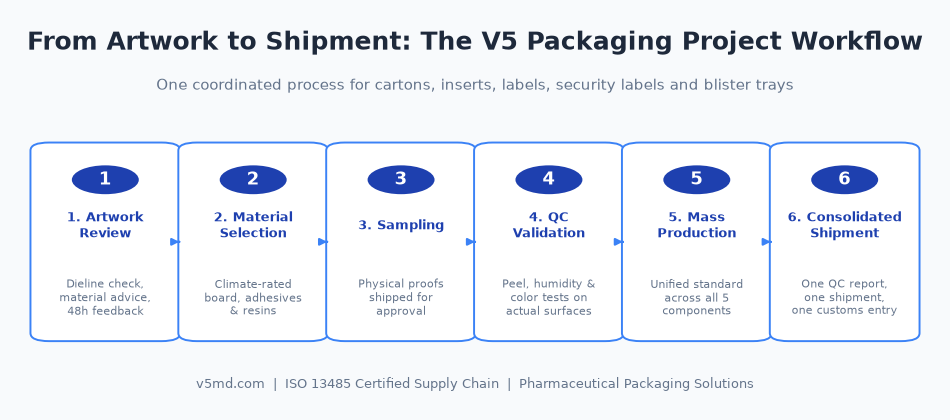
The order at a glance
| Order group | Kit / specification | Quantity | Delivery coordination point |
|---|---|---|---|
| First order | Rabies vaccine packaging kit | 27,000 sets | Eight separate components had to remain countable as one kit family. |
| Second order | Injectable product, two strengths | 30,000 sets: 20,000 + 10,000 | Red and blue carton-and-leaflet specifications used the same folding-carton dimensions. |
| Combined shipment | Both consecutive orders | 57,000 sets | Printed packaging materials and holographic anti-counterfeit labels were produced by two specialist factories and were received and shipped together. |
The first 27,000-set kit contained a folding carton, instruction leaflet, vaccination card with plastic sleeve, vial label, diluent label, outer-bag label, PE outer bag and holographic anti-counterfeit label. The second 30,000-set order had two specifications: 20,000 and 10,000 sets, distinguished by red and blue cartons and leaflets. The same folding-carton dimensions did not remove the need to keep the two specifications separated in the BOM and in the cartons.
Holographic labels are worth calling out. The two orders used 160,000 labels in total—100,000 plus 60,000—not one label per set. Labeling points and normal production wastage mean these quantities must sit on their own BOM lines. Treating them as an afterthought makes reconciliation almost impossible.
The 7-step delivery playbook
1. Freeze artwork and specifications before production starts
Begin with one controlled version of the artwork and specification sheet for every component. The buyer should confirm the final version in writing before plates are made. A correct carton with a superseded leaflet is still a mismatch.
For trademarked packs, the buyer must supply the brand or registration-holder authorisation and the approved locally registered label version before printing begins.
Make the approval pack practical: carton dieline and artwork, leaflet pagination and folding, each label size and application point, bag text, colour convention, language version, and the intended outer-carton marking. Keep the file name, revision and approval date visible. When a change is requested later, decide whether it applies to all components or only a named specification.
2. Build the BOM by kit and by specification
The buyer’s purchase order and BOM should have one line for every component in every kit and every specification. Do not write “two strengths” on a single generic line and expect the factory to infer the split. The 20,000 red and 10,000 blue requirements need separate carton and leaflet lines, even when their folding cartons have the same dimensions.
This is also where the anti-counterfeit labels should be separated from the set count. List the label quantity, the labeling point and the allowance for process wastage as their own traceable lines. The same principle applies to vial labels, diluent labels and outer-bag labels. A good BOM makes it possible to answer: what is required, for which specification, where is it applied, and how will it be counted?
For a deeper component-level sourcing view, see the pharmaceutical secondary packaging guide. Its component map is useful before a buyer asks factories for parallel quotations.
3. Synchronise factories around the slowest component
In this shipment, printing packs and labels were made by two factories. V5 coordinated the specifications, receiving plan and combined shipment, but the schedule still depended on the longest-running component. A factory finishing cartons early does not make a kit ready if the matching leaflets or labels are not ready to receive.
Ask for a shared production plan that names each component, the factory responsible, the expected completion point and the receiving destination. Then use one revision-controlled BOM as the communication reference. This is where an integrator can reduce handoffs: the buyer has one coordinated receiving and shipment plan rather than having to combine two factories independently. The operating model is explained in Integrator vs Trading vs Factory.
The two orders were placed on September 1 and September 13. Both were manufactured and brought to the forwarder’s warehouse by the end of September. That sequence matters: “manufacturing complete” and “ready to depart” are different milestones.
4. Make colour and carton labels do the sorting work
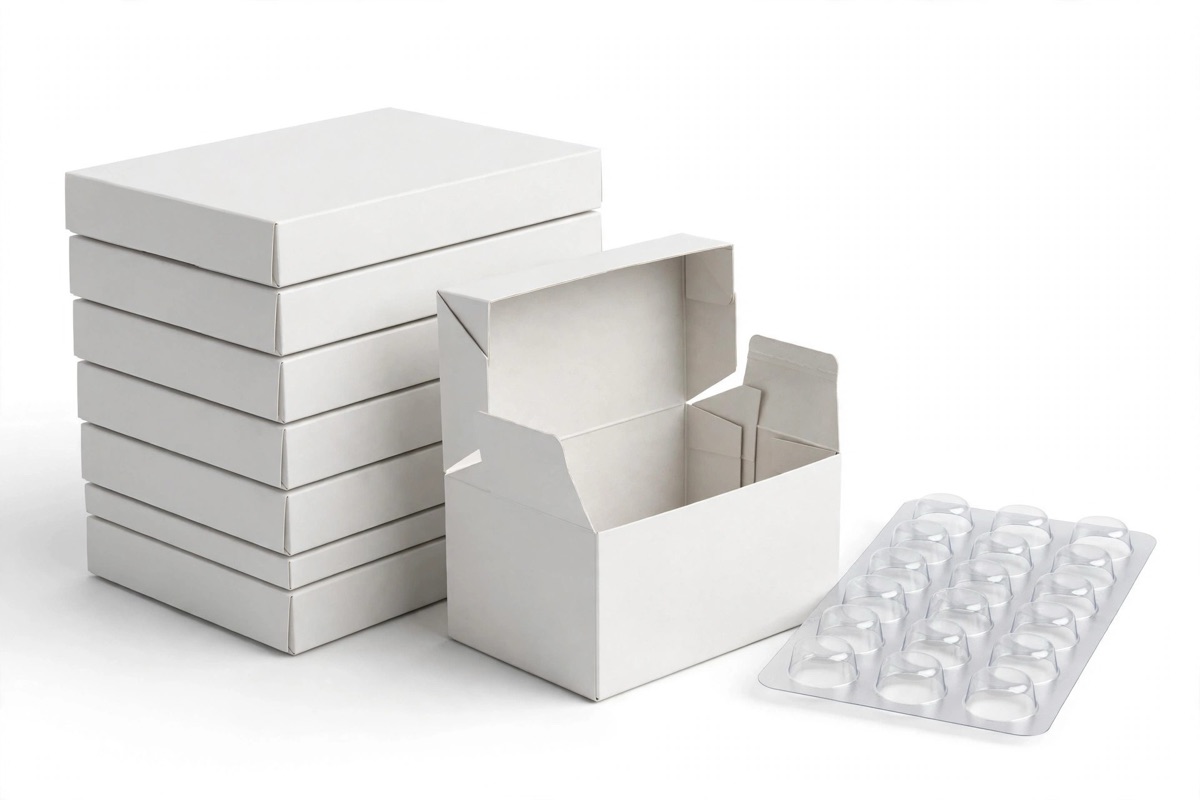
Multi-specification packaging should be intelligible before anyone opens a carton. Factory packing labels should identify the component and its specification, for example color box (green), leaflet (green) or labels. The exact colour names can follow the buyer’s artwork convention; the discipline is to use the same words in the PO, BOM, packing list and physical cartons.
For the red and blue specifications, the carton and leaflet labels need to say which version they contain. The same folding-carton dimensions are not a substitute for product identification. Keep components segmented at the factory so the receiver can assemble the kit without guessing or sorting mixed stacks.
5. Reconcile components and carton labels before release
Before shipment, compare the component counts with the approved BOM and compare the carton labels with the component they actually contain.
Work through a simple matrix: order group, kit or strength, component, approved revision, expected quantity, carton count, carton-label wording and receiver. Exceptions should be recorded before freight is booked, while the relevant factory can still clarify its packing. A photo is useful only as supporting evidence for the carton mark; the controlled count remains the packing record.
Buyers can combine this review with the commercial guardrails described in MOQ vs Unit Price Strategy: ordering clarity is what lets a quotation, a BOM and a delivery plan describe the same scope.
6. Make the packing list match the cartons, not just the order title
One combined shipment should still be readable by components. The packing list for this order was prepared so that cartons and component lines could be reconciled to one order, rather than leaving the destination team with a generic “packaging kit” description.
Include component names, colour or strength designation where relevant, quantities, carton counts and marks. If a component is supplied in extra quantity for a labeling point or wastage allowance, keep it separate from the kit count. This helps the buyer receive 57,000 intended sets without treating every loose label as an error.
The packing list should travel with the warehouse handoff. It is the bridge between the factory’s segmented cartons and the customer’s assembly plan. It also gives the freight forwarder a concise description of what is being consolidated.
7. Plan combined sea shipping backwards from departure
The shipment moved from Shenzhen to Manila as a combined sea-freight load of approximately 3 CBM. Combining two consecutive orders simplified the destination handoff, but it also showed why the shipping milestone—not the factory completion date—must drive the schedule.
The goods reached the warehouse on September 30. China National Day then closed the freight forwarder, so booking could only be made after the holiday. The practical lesson is to plan backward from the desired departure: warehouse receiving cutoff, forwarder operating calendar, document deadline, consolidation time and factory release all need dates. Apply the same discipline before Spring Festival, when a “finished” order can wait if a booking window has already closed.
Buyer checklist before you release a kit order
- [ ] Written approval of one artwork and specification version per component.
- [ ] Trademark or registration-holder authorisation and approved local label version supplied before printing, where applicable.
- [ ] A BOM line for every kit component and every colour, strength or language variant.
- [ ] Anti-counterfeit labels and other non-one-per-set labels listed separately, including application points and wastage allowance.
- [ ] Factory schedules and warehouse receiving instructions aligned to the slowest component.
- [ ] Carton labels state the component and specification in the same terms used in the BOM.
- [ ] Component counts, carton marks and the packing list reconcile before freight release.
- [ ] Sea-freight booking plan accounts for warehouse cutoffs and public holidays.
Need a coordinated packaging-kit quotation? Start with the pharmaceutical packaging category or request a quote with your BOM and artwork revision list.
Frequently Asked Questions
1. Why should each strength or colour have a separate BOM line?
Because a generic line cannot prove which carton, leaflet and label belong to each specification. Separate lines make quantities, revision control and carton labels reconcilable.
2. Why can holographic label quantities exceed the kit quantity?
They may be applied at more than one point and may include a process wastage allowance. Listing them separately prevents the extra quantity from being mistaken for a kit-count error.
3. Is factory completion the same as a shipping-ready date?
No. Components must be received, reconciled, documented and booked with the forwarder. The forwarder’s calendar can move departure after manufacturing is complete.
4. What should appear on a carton label for a multi-specification order?
State the component and the specification identifier, such as the agreed colour. Use the same wording in the BOM, packing list and warehouse instructions.
5. How should a buyer prepare trademarked pharmaceutical packaging artwork?
Provide written brand or registration-holder authorisation and the approved locally registered label version before printing starts, then confirm the production artwork revision in writing.