Pharmaceutical Secondary Packaging: A Buyer's Guide to Cartons, Leaflets, Security Labels & Blister Trays
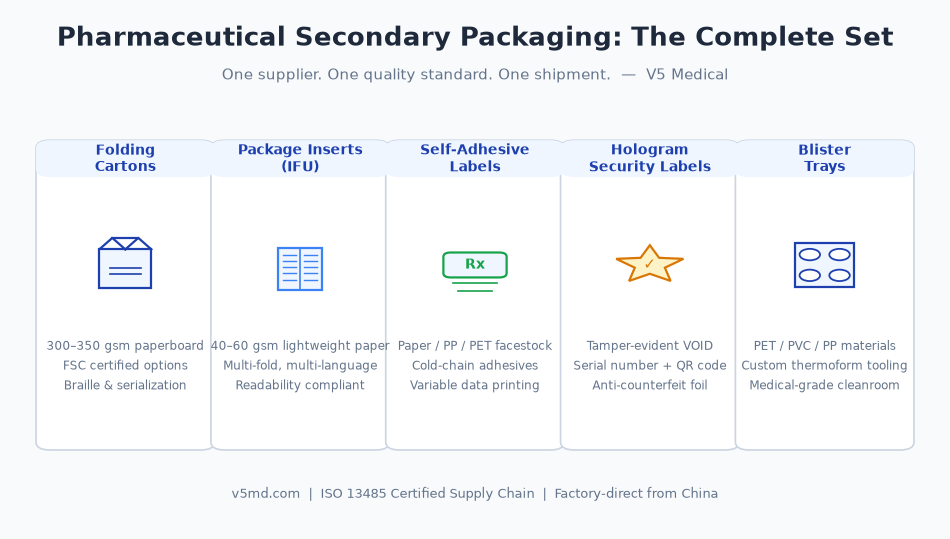
Category: Packaging Solutions Summary: Secondary packaging is where compliance, brand protection and logistics meet. This guide breaks down the five components of a complete pharmaceutical packaging set — folding cartons, package inserts, self-adhesive labels, holographic anti-counterfeit labels and blister trays — and shares what we learned shipping a full set to a Philippine pharmaceutical client.
Most procurement teams source packaging the wrong way: cartons from one printer, labels from another, blister trays from a third factory — and then they discover the label doesn't fit the carton, the adhesive fails in tropical humidity, and the "anti-counterfeit" sticker can be peeled off and reused.
For a component-to-shipment handoff checklist, read How to Deliver a Pharmaceutical Packaging Kit Order Right.
Over the past quarter, we have been supplying a complete secondary packaging set to a pharmaceutical distributor in the Philippines: medicine cartons, package inserts (IFU), self-adhesive labels, holographic security labels and blister trays — all coordinated under one quality standard and shipped as one consolidated order.
This article shares the specification framework we used, so you can apply it to your own packaging procurement.
1. Why Secondary Packaging Deserves Strategic Attention
Primary packaging (the blister, bottle or pouch touching the drug) gets all the regulatory attention. But in practice, secondary packaging is where most market-entry problems appear:
- Regulatory: Philippine FDA labeling rules require specific information hierarchy, font legibility and English-language content on cartons and inserts.
- Commercial: Counterfeit medicines are a documented problem in Southeast Asia. Distributors increasingly demand visible anti-counterfeit features.
- Operational: Labels, cartons and trays must work as a system — dimensions, adhesives and materials must be engineered together.
Treating these five components as one integrated sourcing project — instead of five separate purchases — eliminates the classic failure modes.
2. The Five Components, Specified Properly
2.1 Folding Cartons (药盒)
| Specification | Our Recommendation | Why It Matters |
|---|---|---|
| Paperboard | 300–350 gsm SBS / ivory board | Stiffness for automated packing lines |
| Certification | FSC-certified options available | Increasingly required in tenders |
| Printing | CMYK + spot color, matte/gloss lamination | Brand consistency across SKUs |
| Special features | Braille embossing, serialization zones | EU/PH compliance for certain drug classes |
Common mistake: Choosing board by price alone. A 250 gsm carton that collapses in Manila's humidity costs more in rejected shipments than the 3% you saved.
2.2 Package Inserts / IFU (说明书)
- Paper: 40–60 gsm lightweight opaque paper — thin enough for multi-fold, opaque enough for double-sided print.
- Folding: Cross-fold vs. parallel-fold must match the carton's internal dimensions before printing plates are made.
- Content: Multi-language layouts need professional typesetting — machine-translated inserts are a regulatory red flag in the Philippines.
2.3 Self-Adhesive Labels (不干胶标签)
| Layer | Options | Tropical Climate Choice |
|---|---|---|
| Facestock | Coated paper / PP / PET | PP or PET — paper absorbs moisture |
| Adhesive | Acrylic (general) / hot-melt / freezer-grade | High-tack acrylic rated 10–40°C, 90% RH |
| Finish | Varnish / lamination | Lamination for scuff resistance |
Pro tip: Always specify the application surface (carton board? PET blister? HDPE bottle?) — adhesive selection depends on it.
2.4 Holographic Anti-Counterfeit Labels (镭射防伪标签)
This was the component our Philippine client cared about most — and the one most buyers underspecify. A real security label is a 5-layer engineered system, not a shiny sticker:
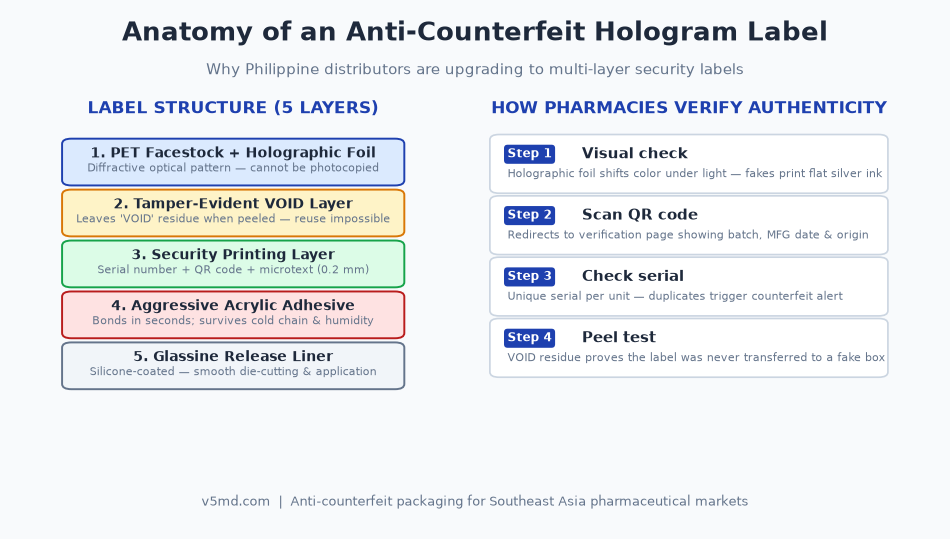
The four verification layers work together: the holographic foil defeats photocopying, the tamper-evident VOID layer defeats label transfer, the unique serial + QR code enables per-unit authentication, and microtext defeats casual reproduction.
Counterfeit Alert. > If your "hologram label" supplier cannot tell you which layer provides tamper evidence, you are buying decoration, not security. Ask for a peel test video before placing the order.
2.5 Blister Trays (吸塑托盘)
- Materials: PET (clarity, recyclable), PVC (lowest cost, thermoforms well), PP (heat resistance). For pharmaceutical use, specify medical-grade resin with a declaration of conformity.
- Tooling: Custom thermoform molds are a one-time investment (typically a few hundred to low-thousand USD depending on cavity count). Amortize tooling across annual volume — see our MOQ vs Unit Price analysis.
- Fit: Tray cavities must be designed against the actual device, with samples validated before mass production.
Looking for a pharmaceutical packaging supplier? > Skip the theory — send us your dielines or target specifications and get a quotation with free samples.
👉 Get a Free Quote · View Packaging Products · WhatsApp response within hours
3. Quality Control: What We Check Before Shipment
Every packaging order leaving our network passes a documented inspection. For the Philippine shipment, our QC checklist included:
- Carton compression & humidity test — 24h at 40°C / 90% RH simulation
- Label adhesion test — 180° peel test on the actual application surface
- Hologram peel test — VOID residue verification on every batch
- Color matching — Delta E measurement against approved proofs
- Dimensional fit — insert-to-carton, label-to-panel, device-to-cavity

For sterile barrier systems specifically (pouches rather than cartons), the validation logic is different — see our guides on Tyvek vs. medical paper and comprehensive packaging validation.
4. Philippine Market Notes
Based on this and previous Philippine projects:
- Your importer needs an FDA License to Operate (LTO), and drug products require product registration with the Philippine FDA before marketing. Packaging artwork should be aligned with the registered product information.
- Labeling language: English is standard and accepted; ensure the registered brand name and generic name appear with correct prominence.
- Climate engineering is non-negotiable: specify adhesives, laminates and board for hot, humid logistics — Manila warehouses are not air-conditioned by default.
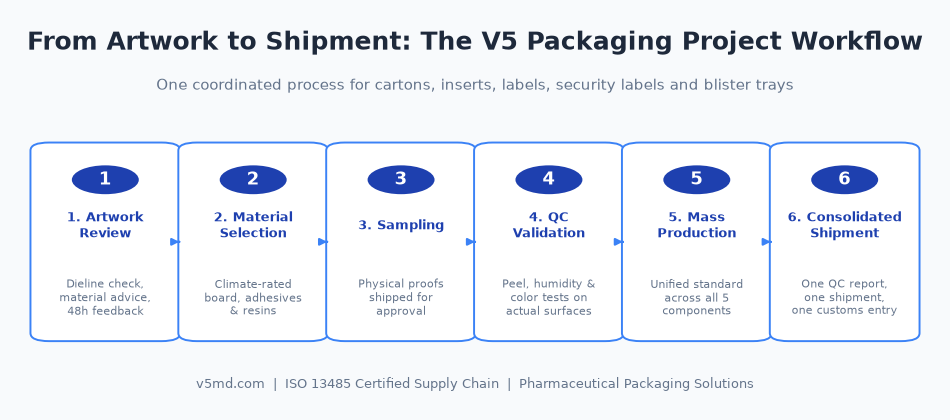
- Consolidation saves real money: five packaging components from one coordinated supplier means one QC standard, one shipment, and one customs declaration instead of five.
5. Real Project Experience
Specifications are easy to write. Execution is what counts. Two recent examples from our packaging network:
Philippines — Complete Secondary Packaging Set (2026). A pharmaceutical distributor needed cartons, inserts, self-adhesive labels, hologram security labels and blister trays for a product line launch. Instead of managing five vendors, they received one coordinated package: unified artwork review, climate-engineered materials (90% RH rated adhesives and board), a single pre-shipment QC covering all five components, and one consolidated sea shipment to Manila. Result: zero mismatch issues between components and a packaging cost reduction versus their previous multi-vendor setup.
Turkey — Regulatory Documentation Support. A premier Turkish distributor faced a local MOH audit with incomplete supplier documentation. Our team delivered a full technical documentation package — material declarations, QC records and traceability files — that helped them pass the audit and retain their market position.
We do not publish client names. References are available on request during the quotation process.
6. Sourcing Checklist for Your Next Packaging Order
Before you request quotations, prepare:
- [ ] Dielines or dimensions for cartons and trays
- [ ] Artwork files (vector, with fonts outlined)
- [ ] Target annual volume per SKU (for tooling amortization)
- [ ] Application surfaces for each label type
- [ ] Required security features (VOID? serial? QR?)
- [ ] Destination climate and storage conditions
Send these to a supplier and you'll get a quotation in days, not weeks. And if you want to test quality first, samples ship via our fast-lane payment system.
Frequently Asked Questions
1. What is pharmaceutical secondary packaging?
Secondary packaging is everything that protects, identifies and sells the product without touching the drug itself — folding cartons, package inserts, labels, security seals and blister trays. It carries your regulatory information, branding and anti-counterfeit features.
2. Can you customize pharmaceutical packaging with our artwork?
Yes. We support fully customized sizes, materials, printing and finishes. Send your vector artwork (or just a dieline sketch), and our team returns a technical review with material recommendations and a quotation, typically within 48 hours.
3. What is your MOQ for cartons, labels and blister trays?
MOQ depends on component and customization: digitally printed cartons and labels can start from small pilot runs, while custom blister tray tooling requires higher volumes to amortize the mold. We offer flexible MOQs for trial orders — see our MOQ vs unit price analysis.
4. Can you provide samples before mass production?
Yes. Sample confirmation is standard practice: physical samples or pre-production proofs are shipped for approval before any bulk run. Samples under $500 can be paid instantly via our secure payment portal.
5. Do your hologram labels really prevent counterfeiting?
Our security labels are a 5-layer system: holographic foil (anti-photocopy), tamper-evident VOID layer (anti-transfer), unique serial numbers with QR verification, and microtext. No single feature stops counterfeiting alone — the layered system is what makes replication uneconomical.
Ready to consolidate your packaging supply? > We supply the complete set — cartons, inserts, labels, holographic security labels and blister trays — engineered as one system, QC'd as one batch, shipped as one order.
👉 Browse our product catalog or request a packaging quotation — WhatsApp response within hours.
Alden Cheng is the founder of V5 Medical, an ISO 13485-aligned medical supply chain integrator serving pharmaceutical and medical device distributors across Europe, the Middle East and Southeast Asia.